Current Work
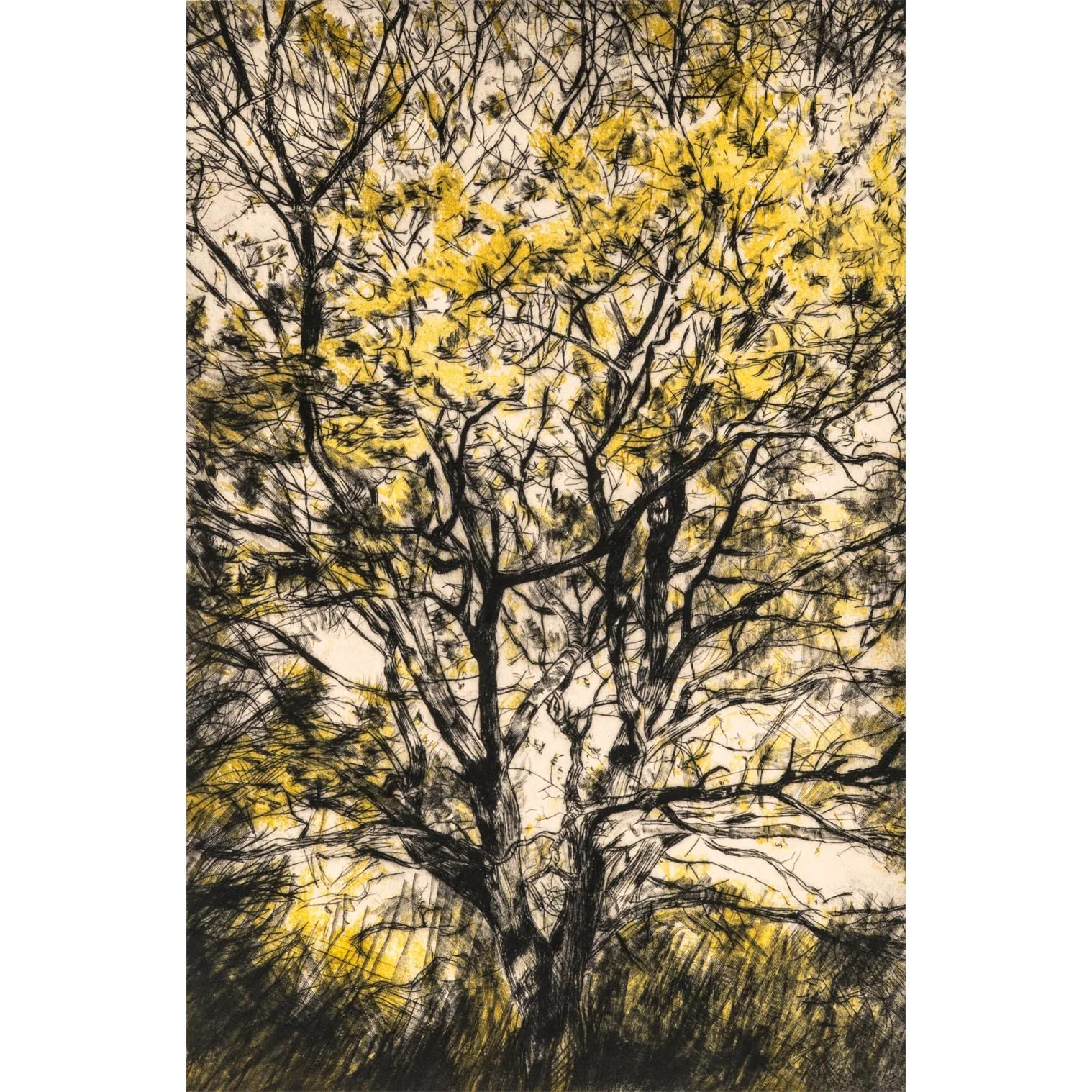
Much of my practice is informed by ecological writing and research, including the book by Suzanne Simard, ‘Finding the Mother Tree’. I work in etching and lithography, usually drypoint with chine collé and occasionally lithographic layers to introduce colour and tone. The photograph below shows a selection of prints in the series as exhibited at Paintworks, Bristol, January 2023. Prints from this series have also been exhibited at Woolwich Contemporary Print Fair, Wells Art Contemporary, Print Rnyngwladol Print International, Spike Open, The Gallery at Green and Stone, Bath Society of Artists Open Exhibition, Bainbridge Open and many others.

Mother Tree series exhibited at Paintworks, Bristol - Jan 2023.
I depict landscapes that have an emotional impact. A recent collection of etchings are taken from the area around the River Dart that I visited during a previous summer. The peaceful landscape was calming and relaxing, and I visited the writer Agatha Christie’s holiday home, Greenway, on the banks of the river, which provided inspiration for a number of her stories. Each print in the series has a title based on a literary quote about nature, amended to fit the image and space.
Many of the trees I draw are from my local park, Greville Smyth Park and the nearby Ashton Court Estate in Bristol. All were once part of the same estate owned by the Smyth family. I consider how fungi and trees are connected through the wood wide web, then these trees and landscapes I depict are connected through the underground network of mycorrhizal fungi.
I recently wrote an essay, published April 2025, based my use of chine collé tissue in my etchings for the CFPR’s Impact Journal which can be read here: The Subtleties of Colour: Can Colour be Used to Evoke Sublime Qualities?




‘Finding the Mother Tree’ by Suzanne Simard details her discovery of the ectomycorrhizal fungal network under the forest floor, the so called the ‘wood-wide-web’ connecting individual trees, protecting seedlings from infection and delivering nitrogen which would be otherwise inaccessible to trees. The removal of trees in urban environments and deforestation has a severe effect on biodiversity of mycorrhizal fungi. Replanting trees is not enough to restore forest ecosystems: mycorrhizal fungi and microbial communities need to be restored as well. Botanist Simard has spent years working on this theory, discovering what it means for forests, the climate and the wider Anthropocene.
I use elements of the sublime to draw the viewer into an ethereal landscape that has an impact on our sense of place in relation to the natural world. I aim to highlight the importance of ancient and mature trees in healthy ecosystems. This theory offers the potential for positive change through knowledge.